The Midi-Coach for Groups of 25 to 35
The midi-coach is the step between a minibus and a full-size Reisecar. It suits a club outing, a class with its teachers or a wedding party, and it fits where a big coach struggles.
Why choose the smaller coach
Narrow streets, old towns and mountain villages are easier with a shorter vehicle. A hotel forecourt or a village church square often has room for one, not for a 57-seater. Luggage space is smaller, under the floor or at the rear, so a ski group of 30 may still need the full-size coach.
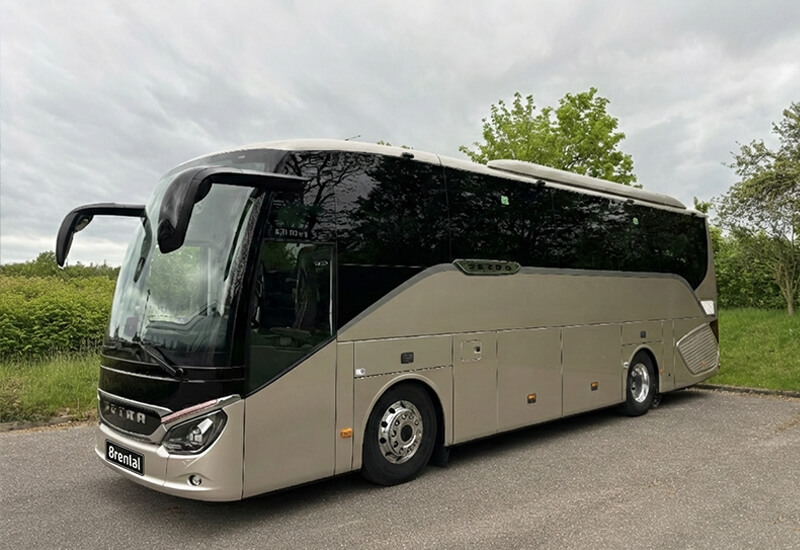
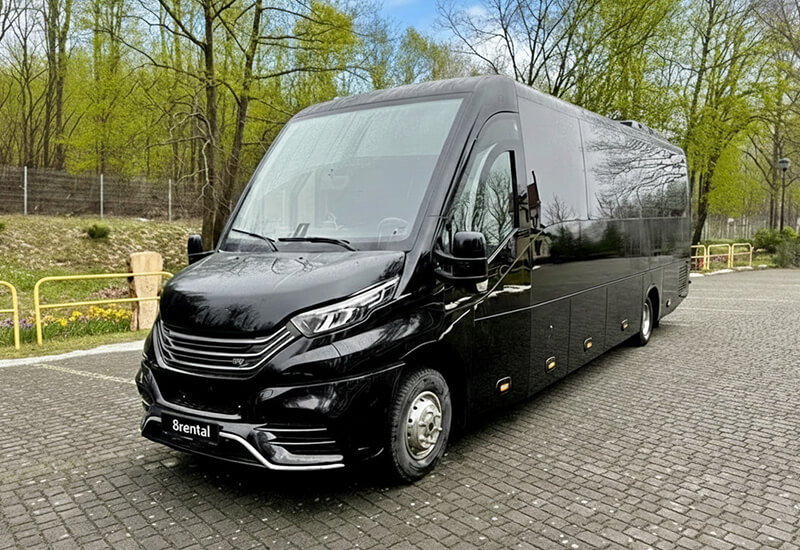
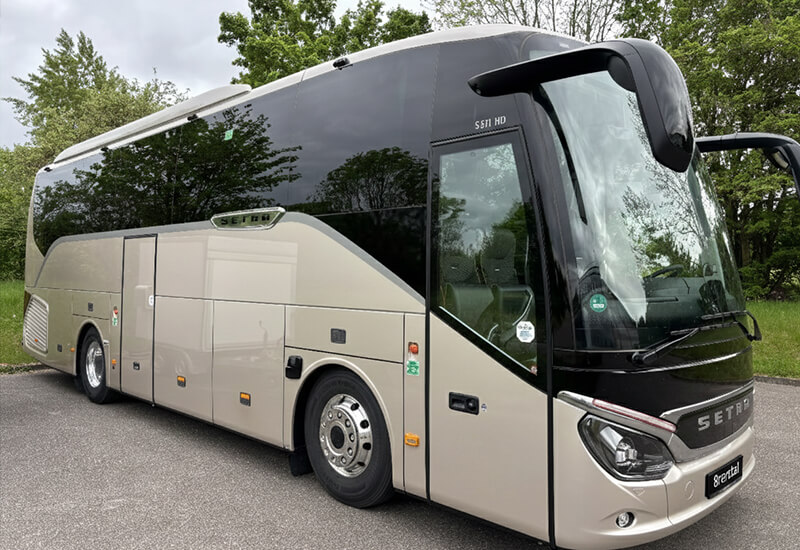
Seats and bags
- Seats: 25-35
- Luggage: Underfloor or rear luggage space, smaller than a full-size coach
On board, and the rules that apply
- Easier than a full-size coach in narrow streets, old towns and mountain villages
- With more than 16 seats besides the driver it needs a category D licence rather than D1 (Art. 3 Abs. 1 and 2 VZV)
- ARV 1 sets at most 9 hours of driving a day, which may be extended to 10 hours twice a week, at most 56 hours a week and 90 hours in two consecutive weeks (Art. 5 ARV 1)
- After 4.5 hours of driving the driver takes a break of at least 45 minutes, which may be split into 15 minutes followed by 30 minutes (Art. 8 Abs. 1 and 2 ARV 1)
- Daily rest is at least 11 hours, reducible to 9 hours at most three times between two weekly rests (Art. 9 ARV 1)
- On a single round trip (Rundfahrt) the driver may postpone the weekly rest for up to twelve consecutive 24-hour periods if the vehicle has a digital tachograph (Art. 11a ARV 1)
- On the Lötschberg car-carrying train (Kandersteg-Goppenstein), buses are carried only on the hourly trains for large vehicles and only with up to 22 seats; BLS also sets length (12 m), weight (28 t), width and height limits
Licence and driving limits
Seventeen passenger seats or more puts the vehicle beyond the D1 licence, so a midi-coach is driven on a full category D licence, as a big coach is. The ARV 1 hours apply: 9 hours at the wheel a day, 10 on two days of the week, and a ceiling of 56 in one week and 90 in any fortnight.
Every 4.5 hours of driving earns a pause of 45 minutes, or a 15-minute stop followed later by a 30-minute one. Overnight the driver needs 11 hours off, occasionally 9. On a tour that returns to its start with the same group, a coach with a digital tachograph lets the driver push the weekly day off back by up to twelve days, so one driver can cover a whole week away.
The Lötschberg question
BLS loads buses onto the Lötschberg car train at Kandersteg only if it has no more than 22 seats and stays within 12 m and 28 t. Most midi-coaches have more seats than that. Check the seat count before planning the train; otherwise the route to the Valais goes round by road.
What organisers ask us
How many passengers fit?
Typically 25 to 35. The exact number depends on the model the operator supplies, and the quote states it.
Does a midi-coach suit a corporate shuttle?
Yes. For hotel-to-venue loops with 20 to 30 guests at a time, it fills better than a full-size coach and is easier to place at the door.
Can a midi-coach go up to Täsch?
Yes. Like any coach it can use the outdoor area at the Matterhorn Terminal Täsch. Zermatt itself stays closed to it.
More group trips by coach
- Coaches with a Driver for Company Events
- Ski Transfers by Coach: Resorts, Passes and Car Trains
- Coaches for the Schulreise and the Klassenlager
- Coach Hire for Teams, Clubs and Supporters
- Wedding Transport: Coaches for Guests, a Car for the Couple
- Day Trips by Coach: Passes, Lakes and Panoramic Trains
- Cruise Transfers: Rhine Ships at Basel and the Lake Piers
- Accessible Group Travel with a Driver