The Full-Size Coach: 45 to 57 Seats
For a group of about 35 or more, the Reisecar is the natural choice. It seats 45 to 57 and carries the luggage underneath. It is also the vehicle with the most limits on where it can go.
Who runs it and who drives it
A coach company needs an admission from the Federal Office of Transport, renewed every five years, with a copy carried in each vehicle. The driver is at least 21, holds a category D licence and the CZV certificate, and keeps to the ARV 1 drivers' hours, recorded by a digital tachograph.
A one-off group hire needs no federal concession. Round trips that bring a pre-formed group back to its start in the same coach are expressly exempt.
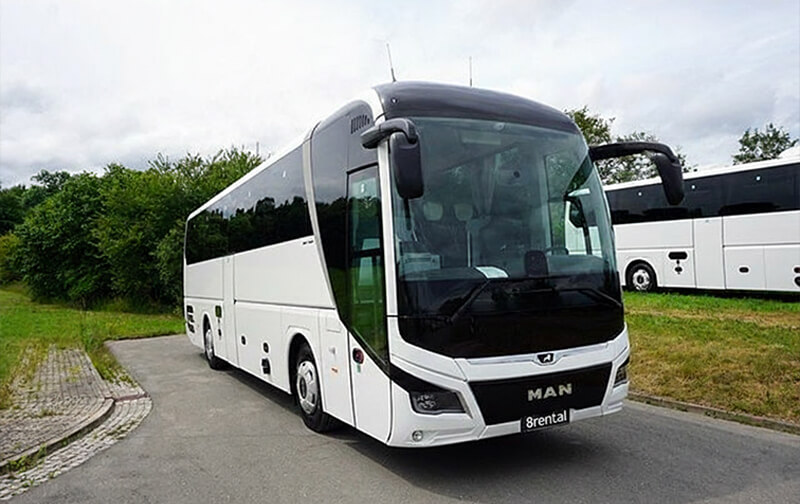
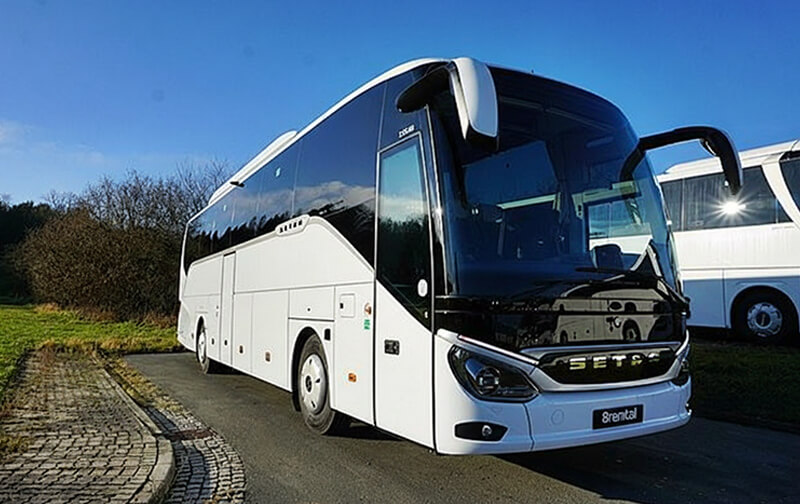
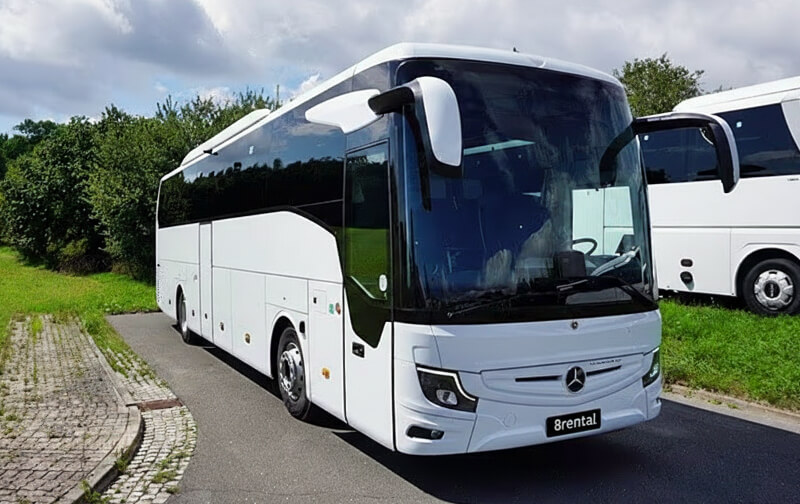
Seats and bags
- Seats: 45-57
- Luggage: Underfloor luggage holds
On board, and the rules that apply
- A company that carries passengers commercially in vehicles built for more than eight people besides the driver needs an admission as a road transport undertaking (Zulassungsbewilligung) under Art. 3 Abs. 1bis Bst. a STUG; it is issued by the Federal Office of Transport (BAV), is valid for five years and is personal and not transferable (Art. 3 Abs. 2 STUG), and a certified copy must be carried on every vehicle (Art. 3 Abs. 3 STUG)
- To be admitted, the undertaking must be reliable, financially sound and professionally competent and must have a real and permanent seat in Switzerland (Art. 4 Abs. 1 STUG)
- The federal passenger-transport concession covers regular and commercial passenger transport (Art. 1 Abs. 2 and Art. 6 PBG); "regular" means more than two trips between the same places within 15 days (Art. 2 Abs. 1 Bst. a PBG). A one-off group hire is not regular, so it needs no concession; trips taking pre-formed groups and bringing each group back to its starting point in the same vehicle (Rundfahrten) are expressly exempt (Art. 8 Abs. 1 Bst. f VPB)
- A coach is a Gesellschaftswagen: a heavy motor vehicle (over 3.5 t) for passengers with more than nine seats including the driver (Art. 11 Abs. 2 Bst. d VTS)
- The driver needs a category D licence, for passenger vehicles with more than eight seats besides the driver (Art. 3 Abs. 1 VZV); the minimum age is 21 (Art. 6 Abs. 1 Bst. e VZV)
- Professional drivers also need the certificate of professional competence for passenger transport (Fähigkeitsausweis, CZV); it is valid for five years and is renewed with 35 hours of further training (Art. 2, 9 and 18 CZV)
- On motorways and semi-motorways (Autostrassen) the limit for a Gesellschaftswagen is 100 km/h; articulated buses and buses on public scheduled services with authorised standing places are excluded (Art. 5 Abs. 2 Bst. a VRV). On other roads heavy motor vehicles may not exceed 80 km/h (Art. 5 Abs. 1 Bst. a VRV), and lower general or signed limits (such as 50 km/h in built-up areas) apply
- Drivers come under the drivers' hours ordinance ARV 1 (Art. 3 Abs. 1 Bst. b ARV 1), and the coach must have a digital tachograph (Art. 100 Abs. 1 Bst. a VTS)
- Where seat belts are fitted, every passenger must wear them while the vehicle is moving, and passengers in coaches must be told about this in a suitable way (Art. 3a Abs. 1 and 3 VRV)
- Coaches pay the flat-rate heavy vehicle fee (pauschale Schwerverkehrsabgabe, PSVA) instead of the motorway vignette (Art. 4 Abs. 2 SVAG; Art. 3 SVAV; Art. 3 Abs. 2 NSAG); for a foreign coach the fee is paid before it becomes due, giving the dates of entry into and exit from Switzerland (Art. 79 SVAV)
- The Swiss Sunday and night driving ban (22:00-05:00) does not apply to vehicles for passenger transport (Art. 91 Abs. 2 and Art. 91a Abs. 1 Bst. a VRV)
On the road
On motorways and semi-motorways the legal limit is 100 km/h. Elsewhere, heavy vehicles may do no more than 80 km/h, less in built-up areas. The coach pays the PSVA heavy vehicle fee and carries no vignette. The Sunday and night ban for heavy traffic does not apply to it. Passengers wear belts where fitted and are told so at the start.
Where a full-size coach cannot go
Four resorts are car-free and closed to coaches: Zermatt, Saas-Fee, Wengen and Mürren. The Lötschberg car train takes buses of up to 22 seats, so a full-size coach to or from the Valais crosses the Grimsel in summer or uses the motorways via Bern and Lausanne. The Vereina car train in Graubünden does carry coaches.
Towns set limits too. St. Moritz Dorf is closed to day-trip coaches, which use two terminals with a 10-minute limit. Luzern's central coach stops need a voucher booked ahead. Interlaken lets passengers on and off only at the two stations, for five minutes.
What organisers ask us
When is a midi-coach the better choice?
With 25 to 35 passengers, in mountain villages, and at hotels with tight forecourts.
Can the same coach take the group abroad?
Yes. Trips across the border and back are allowed. What an EU operator's coach may not do is carry passengers between two Swiss places.
What luggage fits?
The underfloor holds take a full group's cases on most trips. Mention skis, bikes, instruments or folded wheelchairs in the request, so the space can be checked.
More group trips by coach
- Coaches with a Driver for Company Events
- Ski Transfers by Coach: Resorts, Passes and Car Trains
- Coaches for the Schulreise and the Klassenlager
- Coach Hire for Teams, Clubs and Supporters
- Wedding Transport: Coaches for Guests, a Car for the Couple
- Day Trips by Coach: Passes, Lakes and Panoramic Trains
- Cruise Transfers: Rhine Ships at Basel and the Lake Piers
- Accessible Group Travel with a Driver